
Accreditation
Education Excellence
The Montessori Academy of North Hoffman is proudly accredited by the American Montessori Society (AMS)—a distinction that reflects our deep commitment to authentic Montessori education. While schools are not required to be accredited to use the Montessori name, we believe accreditation is essential. Since becoming the 42nd AMS-accredited school in the nation in 1999, we have consistently upheld these rigorous standards.
Accreditation affirms that our teachers are well-prepared, continually growing, and dedicated to their craft. Our curriculum, rooted in Montessori principles, is academically rich, developmentally responsive, and thoughtfully designed to support lifelong learning.
We are also recognized by the Illinois State Board of Education (ISBE), are members of the Association of Illinois Montessori Schools (AIMS), and our Infant and Toddler programs are licensed by the Department of Children and Family Services (DCFS). These recognitions reflect our ongoing commitment to a safe, nurturing, and high-quality educational environment.
What Accreditation Involves
AMS accreditation requires a detailed self-study grounded in clear, measurable standards. This report is submitted to the American Montessori Society to confirm that all standards are being met. Once reviewed, a visiting team is assigned and spends several days on campus observing the school in action and validating its adherence to the Montessori Method. During this time, all supporting documentation is also carefully reviewed. For a school our size, the visit typically lasts three to four days. This process highlights key aspects of our school and governing body. There are nine total standards, and those most closely connected to our learning environment are outlined below:
The Role of the Montessori Teacher
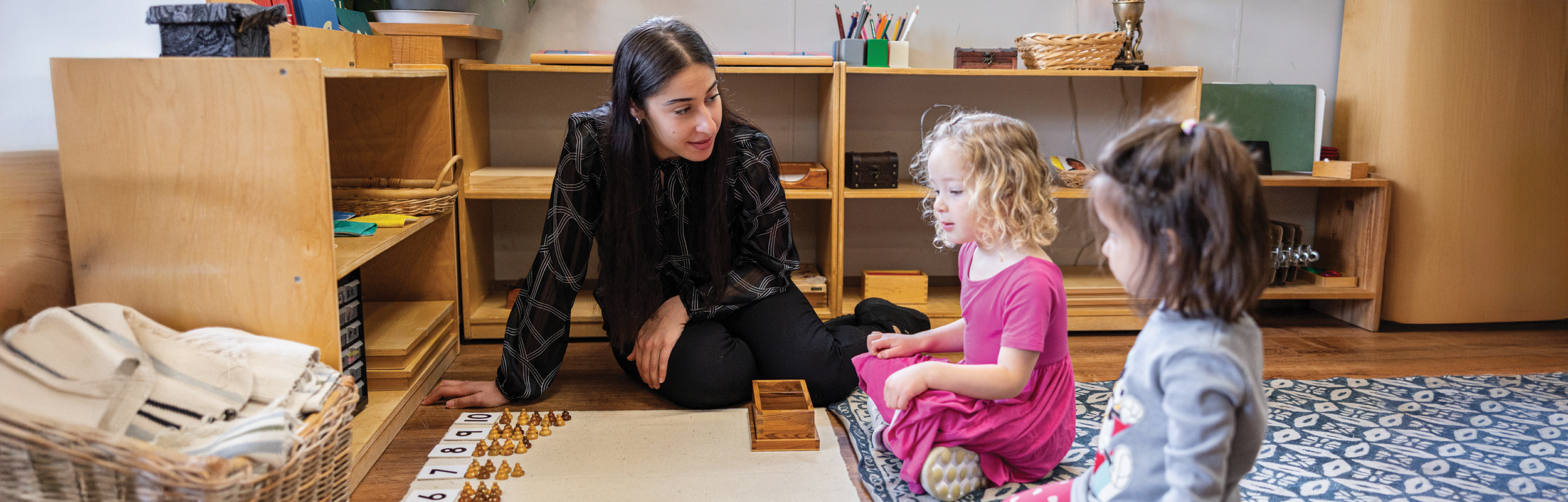
Our teachers are observant, nurturing, and deeply respectful of each child’s unique path. They guide, rather than direct—offering lessons at just the right moment and stepping back to allow for independent discovery. With warmth and consistency, our teachers create classrooms rooted in mutual respect, joy, and purposeful learning.
Montessori educators also cultivate a strong sense of community. They help children understand their place within the group, balancing individual needs with the wellbeing of others. By modeling compassion, patience, and curiosity, our teachers foster the whole child—academically, socially, emotionally, and morally.
The Montessori Learning Environment
At Montessori Academy, we believe a beautiful, peaceful, and orderly environment is vital to a child’s development. Our classrooms are designed to support purposeful activity, independence, and a love of learning. Materials are carefully prepared to be accessible, engaging, and developmentally appropriate—inviting children to explore at their own pace. Maintaining a Montessori prepared environment is one of the key roles of the teacher.
Learning Through Activity
Children are naturally curious. We nurture that curiosity with thoughtfully designed materials and uninterrupted work periods that allow deep concentration and self-discovery. Within clearly defined boundaries of safety and respect, children experience freedom—growing in confidence, responsibility, and joy.
Learning Through Relationships
Montessori classrooms are intentionally multi-age, creating opportunities for peer learning, leadership, and collaboration. Older students model positive behaviors and inspire younger ones, while all children learn to value the unique contributions of their diverse community. Instead of competition, we foster mutual respect and individual growth.
Nurturing the Spirit
We honor each child’s natural spirituality by cultivating an atmosphere of peace, love, and wonder. Teachers model virtues such as kindness, forgiveness, and responsibility, guiding children toward inner harmony and moral understanding. Education in this sense goes beyond academics—it touches the heart.